Doctor Hoo: Mark Esser, PhD ’98
Alumnus Mark Esser, PhD '98, returned to UVA to lead the UVA Paul and Diane Manning Institute for Biotechnology and help transform science into medicines
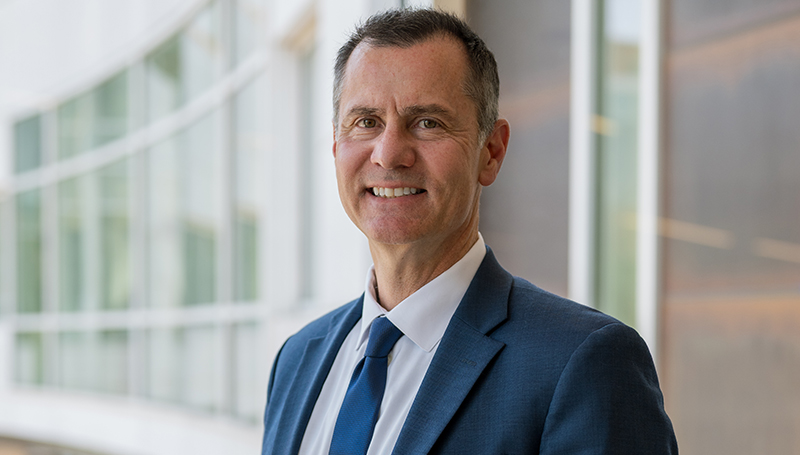
Mark T. Esser, PhD ‘98, returned to the University of Virginia in 2025 as the inaugural chief scientific officer and head of the UVA Paul and Diane Manning Institute for Biotechnology. He is widely recognized for his contributions to vaccine and immunology research with numerous patents and over 130 peer-reviewed publications. His prior roles include serving as vice president of vaccines and immune therapies early research and development for AstraZeneca and director of the Vaccine and Biologics Center of Excellence at Pharmaceutical Product Development.
We talked with him in February 2026 about returning to UVA and his goals for the Manning Institute. This feature originally appeared in the Spring 2026 issue of Virginia Medicine magazine.
What brought you to the University of Virginia as a PhD candidate?
My faculty advisor and mentor at Case Western, Dr. Dennis Templeton, had recommended the University of Virginia as a place to go for my PhD program because of the world-class work folks like Mike Weber, PhD, and Tom Parsons, PhD, were doing back in the ’90s – understanding the fundamental mechanisms of cell regulation, cell cycle, and cell signaling. But equally, and maybe more importantly, it was all about a girl. My girlfriend and then fiancé, Kate, had started at UVA and had transferred up to be closer to me at Case Western in Cleveland, so it was part of our agreement to come back to UVA. We’ve been married for 34 years now and have four kids.
I was thrilled to start my PhD program at the University of Virginia. I did a rotation in the Carter Center for Immunology and became enamored with the immune system. I went from thinking I was going to work on cell cycle regulation into becoming an immunologist.
How did your training at UVA shape you as a scientist and ultimately prepare you for this new role?
It was a rigorous education on how to be a scientist who can do really good laboratory science and communicate it effectively. Also, it was such a collaborative environment where everybody was willing to help one another. That’s still true today, and it’s UVA’s special sauce. Those two things are the foundation of building the Manning Institute – that outstanding, world-class, rigorous science that’s going to move us forward and hopefully cure diseases, and equally, that collaborative team environment where people are happy and willing to work together because that’s when the magic happens.
Prior to coming back to UVA, you were working in industry with AstraZeneca. What inspired you to return to UVA and lead the Paul and Diane Manning Institute?
I was very much enjoying serving as a vice president of R&D at AstraZeneca up in Gaithersburg, Maryland. I was proud to be a part of a great organization, had a great team, and we were working on some important projects that could potentially become new medicines. I ended up talking to Bill Petri, MD ‘82, PhD ‘80, at a National Foundation for Infectious Diseases dinner in Washington, DC. I knew Bill from my time here, and he told me all about the Manning Institute. It was truly a once in a lifetime opportunity to create an institute, literally and figuratively, from the ground up. Truthfully, I would not have considered it if it wasn’t the University of Virginia. Obviously, I have incredibly fond memories of being here, going back to the collaborative nature and just wonderful community. It ticked those two boxes. Then I think the stars aligned on this one, because at the same time, my daughter and her husband decided to move to this area. I don’t think there was any way I was going to say no. I’m a lucky guy.
For those who have been hearing about the Manning Institute but don’t really know what it is, what would you want them to know?
I always like to say there’s only one thing to remember about the Manning Institute, and that’s our mission: to transform science into medicines – to take the fantastic research that’s being done in our basic research and clinical labs and bring folks together around turning molecules into medicines that can one day help people. The goal is to be a catalyst for biomedical research as well as for economic growth here in Charlottesville and all of Virginia.
It sounds like your experience on the R&D side and your mission at the Manning Institute come together well.
Yes. Even in industry, the foundation is rigorous, outstanding science. Without that foundation, you can’t develop a good medicine. Outstanding and rigorous science will also be the foundation on which we build the Manning Institute. We want to be known as a premier research institute with our staff publishing in top-tier journals and patenting their breakthrough work. And then actually taking that next step of using that foundational, world-class science and trying to turn that into innovative medicines. That’s what I hope I bring to UVA and the Manning Institute: teaching our scientists, clinicians and engineers about the next steps in that process, everything from drug discovery to lead optimization to thinking about formulation, bioavailability, and pharmacology. There’s a lot of hard work that goes into turning a molecule into a medicine, and that transformation will be some of the focus in the energy in the Manning Institute.
Adding the human component to that is the other thing that I learned in industry that’s critical for success. Drug development is a team sport. I like to joke that it’s a contact sport because sometimes people are really passionate about their projects. Having teams working on solving these big problems, the whole is always greater than the sum of the parts. There’s synergy when you bring experts together on a team focused on trying to develop a medicine. I think some of that team spirit and organization around what is often referred to as product development teams is something we’ll try to implement at the Manning Institute, recognizing it’s still an academic environment.
Are there particular priorities that you have for the institute at this point?
Priority one was coming up with a clear strategy. Our strategic areas of focus will be, maybe not surprisingly, oncology, immunology, cardiovascular and metabolic disease, neuroscience, and infectious disease. The reason is that those are areas where UVA is already incredibly strong. We’ll layer onto that investments in some key technology platforms from medicinal chemistry to gene therapy, biologics engineering, and then cell-therapy. In addition to some investigators already at UVA taking up residence in the institute, we also plan to hire some of the best of the best to come to UVA to help lead those areas. Creating critical mass and expertise in these therapeutic areas and technology platforms along with creating drug development teams are going to be key ingredients in our recipe for success.
The building that will officially house the Manning Institute is scheduled to open in late 2027. How is that coming along?
Phase one of the building is on schedule to open at the end of 2027. That will get the first three floors of the south wing. We’re still really looking to raise almost another $180 million to complete the building, which will include another approximately 100,000 square feet of research labs, a BioProcess manufacturing space and a Biotech Education Center. Obviously, we have a ways to go, but we are off to a good start, generating positive momentum and plan to get started with phase 1 in 2027.
Speaking of the future, what scientific areas excite you the most right now in terms of their potential to become real-world treatments?
I’m excited about gene therapy and gene delivery. There is some outstanding work being performed by Evan Scott, PhD, and the team at the Nanoscale Scientific and Technological Advanced Research (nanoSTAR) here at UVA. These technologies unlock the ability to not only treat but cure some genetic diseases. I think with the focus, the dedication, and the appropriate investment we can make a big impact in a timely manner.
You mentioned that collaboration is central to the Manning Institute’s mission and its success. How do you envision researchers, clinicians, trainees, and industry partners working together within this new ecosystem?
I think there’s two layers to that answer. First, there’s the microcosm of that ecosystem and then the larger ecosystem that we’re developing here in Virginia. I like to say the Manning Institute is a building, but it’s also an institute without walls. What we envision is having theme-based research versus the traditional department-based research. For example, we’d like to set up an area to focus on glioblastoma or brain cancer research that would be a mix of neuroscientists, geneticists, biochemists, biologics engineers, medicinal chemists, and physicians, all coming together with a common goal of trying to cure brain cancer. And then second, having the Manning Institute serve as the epicenter for collaborative research here in Virginia, where folks from local companies, like AstraZeneca, Merck, Eli Lilly or startup companies, can gather. It will be a place to convene workshops, symposiums, and networking events where people can come together to talk about their research, as well as discuss starting companies and new initiatives that bring together not only scientists, but also entrepreneurs, regulators, and business leaders.
From your perspective, what makes UVA uniquely suited to becoming a biotechnology powerhouse?
It’s almost like the biotech community in Charlottesville became an overnight sensation after 30 years in the making. Obviously, there’s a lot of investment in this space from the state, philanthropists and some big pharma companies. The commonwealth is investing in this space for job creation and UVA is really committed. We are creating a perfect recipe where we have all the key ingredients starting with a strong talent base with world-renowned researchers, bright students coming out of the University, and investment from biopharma, coupled with the right environment between the Manning Institute, the Cville BioHub, and other organizations in Virginia. We need to take advantage of this moment and not just keep the momentum but accelerate it.
What impact do you hope that the Manning Institute will have on patients and public health in the next decade and beyond?
In the near term, my hope is that the first medicine that comes out of the Manning Institute enters clinical trials here at UVA by 2030. This is our grand challenge. Then, to build a sustainable organization that can create medicines reproducibly, where every year we would be moving two or three new medicines into clinical trials. The goal is to help patients and not just treat, but cure disease, because at the end of the day, patients are waiting. The reason we do this is to have an impact on public health – people like our friends, our family, our neighbors. For many of us, we have known people who have had these devastating diseases, and when there are no options, it’s devastating. These people are waiting for cures, and transforming science into medicines to help people is our mission.
Learn more about the UVA Paul and Diane Manning Institute for Biotechnology.